

Derek Owusu is a British Ghanaian writer whose work has become known for its intimate exploration of Black British life, family, masculinity and mental health.
From the award-winning That Reminds Me to Losing the Plot, Owusu has continued to push at the boundaries of form and voice while examining the inner lives of characters often carrying more than they reveal.
His latest novel, The Recovery House, follows Jamal, a writer recovering from a mental breakdown who finds unexpected connection among a group of people navigating their own vulnerabilities. Through friendship, food, faith, humour and the small acts of compassion that hold people together, Owusu explores recovery without neat answers, the risks of turning trauma into story, and the quiet power of being seen by others.
Please introduce yourself…
My name is Derek Owusu, and I am a writer from North London of Ashanti, Ghanaian heritage.
Describe your life currently, in one word or a sentence.
In a constant state of anticipation.
Why are we here?
We’re here to discuss my latest novel, The Recovery House. To get a bit deeper than that, I feel that I’m here to do something, maybe help one person or many, but something that involves making life easier for people in some way.
You’ve spoken about discovering literature when you were studying Exercise Science, and sneaking into English Literature lectures because you couldn’t change your degree. Now you’re an award-winning author. When you look back at that version of yourself, are you surprised at how far you’ve come?
Not in the slightest. I always thought that at 50 or 60 after I’d lived a life worth writing about I’d write a book. But that’s all. I never had aspirations as a child or teenager. I’ve always just fallen into things. I’ve never wanted to be anything; I’ve just always wanted to understand why I’m alive.
From SAFE and That Reminds Me through to Losing the Plot and now The Recovery House, you continue to explore Black British life, masculinity, family and vulnerability. Do you feel like you’re still asking the same questions you were asking at the beginning of your career, or have what you want to understand about the world through your writing changed?
Aside from my debut, which was an attempt to understand myself, I never write with the intention to understand anything or to discuss a topic that has preoccupied me. I mainly write because it feels like I have to. All I’m trying to do is show the reader something and let them make up their mind about it. Mental illness is a common theme in all of my books, but I’m not sure there’s a question at the heart of it. Just many angles that I want to present to the reader.
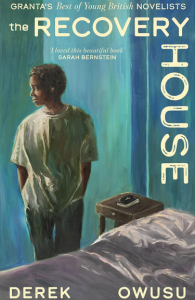
The Recovery House begins with Jamal at one of the lowest points of his life, but what I liked is that the story isn’t just about despair. There’s friendship, humour, music, faith and moments of joy in there too. When you began writing, what was your intention?
This is a strange book for me. I had no idea that I was going to write it. I had just finished writing my third novel and still had this creative energy left over. It was summer and I was quite sad. I’m usually really sad during summer because for the last five of them I’ve been in a recovery house due to my BPD episodes and suicidal ideation. So, I was down and lonely and just decided, lemme try write another book. And it just flowed out of me, like, it was this spiritual rush. It felt like some transcendent experience writing the book. I was incredibly happy while I was doing it, and once I finished, I thought to myself, ‘wow, I really like this’. And I never feel like that. Ever. I had no intention of publishing it and it wasn’t contracted to any publisher at the time. But I felt so good about it that I sent it to my friend Ore and she loved it too and was like, ‘we gotta find a publisher for this‘.
The main character, ‘Jamal‘ is a writer trying to write about his life which overwhelms him. I found that really interesting because writing can be a release, but it can also force you to confront things you might not be ready for. What did you want to explore about that relationship between creativity and mental wellbeing?
I was trying to put a caveat in the book about what we see as autofiction, and the dangers of mining your own suffering for the entertainment of others. I also wanted to present the question of who gets to write whose story, and at what point can a person give enthusiastic consent to their trauma being turned into a story. The characters in the book have almost zero backstory for that reason. I mean, even when it’s your own story, how do you know you’re ready to put it out there? What if you change your mind a few weeks before publication? And the thing with writing your trauma and seeing it as cathartic, is that it can trick you into thinking you’ve dealt with that trauma on the page. When realistically you haven’t, your character has, and so often I imagine that what you thought you had dealt with in a novel, comes back to you and catches you by surprise.
The Recovery House brings together people of different ages, races and backgrounds who might never otherwise have crossed paths, yet they become this unexpected community. What interested you about putting these particular characters together, and what did you want them to reveal in each other?
I never think about it in terms of what this character will bring out of another. I just write, inhabit the character and then see what follows. If it feels like it rings true, then I know I’m onto something and can keep working it in the edits. It’s really hard to explain character choice. I personally think it all happens subconsciously. But one character I was conscious of wanting to write about was ‘Gokhan‘. Growing up in Edmonton and Tottenham, I was close with a lot of Turkish Londoners and we shared many stories. It’s something I’d love to explore later in my career.
Something I really liked was that Jamal connects with everyone differently. There isn’t one person who suddenly understands him or fixes everything. He seems to take something different from each relationship. Was that important when you were thinking about what recovery and human connection look like for him?
Yes. I didn’t want anything to be neat. And because I wasn’t writing these extensive backstories for each character and they would only be seen through the eyes of Jamal, it was important that what I believe to be ‘fundamental human decency’, the small details, acts of thoughtless compassion, came through with each character interaction in their own idiosyncratic way.
There’s a moment when Jamal bonds with another male character whilst cooking oxtail. Why did you choose food as the vessel to explore Black British identity and how different generations experienced Britain?
Food is integral to any culture and identity. It’s a very easy binding agent. But what I wanted to explore is their relationship to those foods. Jamal shares food more often than he eats it and is always aware when someone isn’t eating. Speaking for my culture, this is a very West African thing – an invitation to eat always being offered. In the context of the recovery house, it’s just compassion for people in a similar situation to him.
There’s still this idea that Black men should carry things quietly or somehow ‘just get on with it‘. With Jamal, how much did you want to challenge that and explore the ways Black men deal with, express or even hide their pain?
I wanted to include some elements of Jamal hiding his pain but not too obviously. There are moments in the book when he dissociates and begins to recall or see the world through the lens of something that gives him comfort. As long as the reader is aware that he is trying but failing, I think that’s enough of a challenge to the prevailing narrative. All we can do is try. The courage in the attempt is what we should take from witnessing Jamal’s experiences.
Your writing style was probably one of the first things that hit me. There’s very little punctuation or traditional sentence structure and, at first, it felt quite chaotic. But once I found Jamal’s rhythm, it started to feel like I was inside his head rather than just reading his story. Why did you decide to write The Recovery House in that way?
It was just the voice that came to me if I’m honest. Like I said, I didn’t know I was going to write the book. But when I started, the voice was just there, fully formed and clear to me. And I just knew instinctively what the style was supposed to be. The style also highlights, without too much complication, what it’s like in the mind of someone who has just suffered a mental breakdown. They revert to this childlike innocence a lot of the time, so Jamal is almost seeing parts of the world anew, along with its scary aspects, and his thoughts flow like a river. It’ll be described as stream of consciousness, I’m sure, and it’s definitely a version of that, but true stream of consciousness is incomprehensible. James Joyce did it well in an early chapter of Ulysses, but it’s so confusing. Because that’s what true stream of consciousness is. Time collapses, coherence is nonexistent, images blur, words, songs, phrases flow in and out of this utter mess of thoughts.
Because there are only a few obvious pauses, I found myself reading some parts really quickly and then naturally slowing down in others. Did you want the reader to have that freedom with the pacing, and almost experience his state of mind rather than just be told what he’s feeling?
Yes, exactly that. The reader can find their own rhythm, though of course I wrote it with my own, and maybe they’ll find it. Once they do, the words flow through you, hopefully providing some aesthetic pleasure along the way, with meaning becoming secondary.
There’s this question running through the book about the voices we listen to and how we understand them. Is it God? Is it creativity? Is it instinct? Is it illness? With Jamal being a writer but also going through a mental health crisis, what made you want to explore that line between faith, creativity and what we might call madness?
This is a difficult question to answer. I wish I had something clever to say about it but honestly, I don’t know. This is something I owe to my subconscious.
Everyone in the Recovery House is there because they’ve reached an incredibly vulnerable point in their life, but we don’t only see them through that. They’re funny, caring, complicated, all of those things. How important was it to you that their mental health never became the only thing that defined them?
Incredibly important. That these people are ill is established through the fact they’re in the recovery house. So from that starting point, I don’t need to add much more about it to establish who they are. There is so much more to explore: human connection, friendship, fiction and fact, art, faith, faith in oneself, in others, and of course, the idea of what we may call the divine.
Who are the people you lean on when writing?
No one. I’m very much living in my head while writing. Anyone outside of it is a distraction. I’m terrible to be around when I’m writing.
Three tips for writers …
- Trust your own voice before you try and write another’s.
- Don’t be too eager to share drafts with anyone willing to read them.
- Trust your instinct and don’t be too lazy to listen. Deep down, we know when something isn’t working or when a sentence is bad.
GETTING TO KNOW YOU …
If not this, then what? I honestly have no idea.
What’s made you sad, mad, and glad this week? Sad, spending money. Mad: nothing. Glad: started reading some Steinbeck.
What are you watching? Just starting Atlanta. Very late to the party.
What are you reading? The Pearl by John teinbeck.
The last film you watched? Spiderman Brand New Day. It was aight.
The last play you saw? Hamlet.
The last live music event you attended? Something years ago. I think it was Stevie Wonder and Lionel Richie in the park.
What’s currently on your music playlist? Loads of random songs. My current get hype gym song is Une vie à t’aimer by Lorien Testard. From the soundtrack of Expedition 33.
Which song are you listening to on repeat at the moment? Outside of the gym, it’s Across 110 Street by Bobby Womack.
Which podcast(s) are you currently listening to? None at the moment.
What’s on your bucket list? To go to Jamaica.
Where’s your happy place? In front of my PlayStation or on the Victoria line with a novel.
Celebrate someone else, who’s doing great work right now? So many. Courttia Newland has just dropped a great book called The Art of Opposition. Eden Mckenzie Goddard’s novel Smallie is great. And looking forward to Henry Hoke’s new novel.
Celebrate yourself … Honestly, I’m proud that I’m still here.
What’s next? My next novel. Which is almost finished (in my head). So I’ll probably begin writing that late next year.
Where can we find you? On Instagram DerekVsOwusu
Where can we see or hear your work? Some of my books are available in bookstores. But all of them are available on Audible.