

Shereener Browne is a British actor, former criminal barrister and co-founder of Orísun Productions, a company dedicated to creating opportunities for African and Caribbean creatives.
Her latest initiative, The Windrush Prize for British Caribbean Playwrights, is the first major initiative of its kind in 30 years, dedicated to discovering, developing and championing British Caribbean playwrights. Inspired by her late father’s experience of the Windrush scandal, Browne has used his compensation award to create opportunities for emerging writers, with the winning play receiving a professional production at Arcola Theatre.
Browne discusses the deeply personal story behind the prize, the barriers facing British Caribbean playwrights, her journey from law to theatre, and why preserving and sharing Caribbean stories is essential for future generations.
Please introduce yourself …
My name is Shereener Browne, I’m a Libran of Kittitian & Nevisian heritage currently living in the Peoples republic of New Cross Gate, Lewisham.
Describe your life in one word or a sentence …
Love intertwined with Resistance.
Why are we here?
To make love and resist!
The Windrush Prize is the first major initiative of its kind in 30 years dedicated to British Caribbean playwrights. Why do you think it’s taken so long for something like this to come about, and what does that say about where we are when it comes to representation in British theatre?
I think that after George Floyd was murdered and we saw the rise of the BLM movement, white people who hold power in this industry went into a slight hand-wringing panic. When people respond in a panicky, knee-jerk way, nuance and the detailed work of finding lasting solutions to dismantling discrimination lose out.
As a result, different underrepresented groups were lumped together, with little or no regard for how the system impacts individual groups. This broad-brush approach is why we still have systemic underrepresentation in the arts generally.
That’s why it has taken so long for a project like this to come along, because on the surface, it looks like everything is fine and dandy. We have a few high-profile Black British actors breaking through. What more could we want?
I had the pleasure of attending the launch of The Windrush Prize; it was such a lovely evening. It was particularly interesting learning about parts of Black British history I wasn’t aware of. I know the prize is deeply personal to you; please share a little about your father’s story and how his experience led you to create it …
My father was born on Nevis when the island was still part of the Empire. He never held anything other than a British passport. He was raised to consider himself British, an identity he carried everywhere with him, even when, after over twenty years in this country, working, marrying and starting a family here, he migrated to the US.
He always planned to return here, to the place he considered home. But changes in immigration law left him without a passport and effectively stranded in the US. I began the battle on his behalf to have his status as a British citizen reinstated.
I saw the impact this denial of his identity had on him. I saw how he retreated into himself, taking his stories with him. This prize is my way of giving life to our stories.
Your father sadly passed away before receiving the compensation he was awarded following the Windrush scandal. You’ve now taken that money and created something that will benefit future generations. That must have been quite an emotional decision. How did you get to the point of deciding the Windrush Prize was what you wanted to do with it?
For a long time, I have wanted to play a part in helping Black stories be told on stage. It was not until the compensation was paid that I finally had the means to help in a truly meaningful and lasting way.
I also knew through my work with Black creatives that the real issue was not a lack of talent but a lack of opportunity. I wanted a project that would help to reinvigorate storytelling in the Caribbean community and increase the number of plays written about our community.
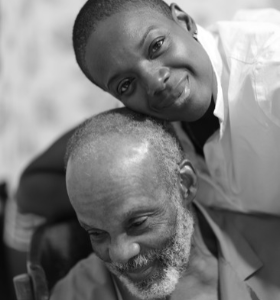
Shereener and father Myron Browne
You’ve spoken about wanting to honour your father’s memory through the prize. What do you think he would make of what you’ve created and the opportunities it’s going to give other people?
My dad was one of 19 children, born into a farming family on a tiny island in the Caribbean. He was a quiet, shy and humble man.
He would be truly astonished at this achievement, that something like this could come from truly humble beginnings. He would think: we are little but we are talawa.
We often talk about the importance of telling our own stories, but getting those stories onto major stages is another challenge. From your experience in the industry, what do you think are some of the biggest barriers facing British Caribbean writers?
I think the biggest barrier is the lack of financial support, perhaps mixed a little with self-doubt, exacerbated by how few successful British Caribbean writers are out there making a living.
There is also the lack of commissioning of new work and risk-averse programming. All of this, and more, erects an almost insurmountable barrier for most aspiring writers, permitting only a few to break through.
There’s such a rich history within our Caribbean communities, and so many stories that haven’t necessarily been explored on stage. Are there particular stories or experiences you’re hoping the prize will encourage people to tell?
Yes, ordinary stories compellingly told. Stories of Caribbeans falling in and out of love. Relatable stories with emotional depth. Your story. The story of our grandparents. Our ancestors. All deserve to be heard.
The winning play will be published and professionally produced at Arcola Theatre. How important was it for you to make sure the winner received that level of support instead of just a financial award?
We know that there have been Caribbeans writing about their experiences in the UK almost from the moment we got here! And yet, those stories have been lost. Erased. Academics are researching to uncover those lost pieces of work.
I wanted to address the issue of our lost canon. You will be able to buy the play. To hold a physical copy in your hand. To watch the story unfold on stage. It will be part of the archive; the legacy. Reminding the world that we were here.
Can we talk a little about your journey? Your career so far has been very interesting. You were a criminal barrister before moving into acting and eventually founding Orísun Productions. How did that transition happen, and is working in theatre something you’ve always wanted to do?
The transition happened accidentally! Or, as my mother would say, God had a plan; I was perhaps laughing!
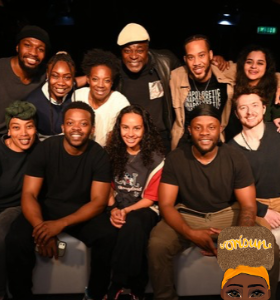
I took a break from law to raise my three children and care for my mother. Anyone who is a full-time carer knows how physically and emotionally demanding it is. I needed to have something that was just for me, not linked to my role as a mother, wife and carer.
So, I escaped into acting at my local black box fringe theatre. But performance was in my blood. I was raised in Leeds in the carnival tradition. My mother, Edris Browne, was a carnival queen as well as a costume designer and maker. It is no accident that I enjoy dressing up and performing; it’s basically what I have done my whole life, from carnival troupe to criminal barrister to actor.
You founded Orísun Productions with Seun Shote in 2018, creating a space for African and Caribbean creatives to develop their work. What was missing from the industry at the time that made you feel you needed to create that space yourselves
What was missing, and is still missing in my view, were non-stereotypical roles for Black actors. Seun and I were tired of only being asked to audition for gang members or, for me, the mother of a gang member.
We are actors. Let us act. Let us use our imagination to create characters with depth and nuance. We knew no one would cast either of us as leads; we had to make that work ourselves.
You’ve already been running workshops around the country, and you’ve mentioned meeting people who hadn’t even considered themselves playwrights before. Has anything surprised you about the response so far, particularly from people who might not have seen theatre as a space for them?
I have been surprised, but at the same time, not surprised. I knew there was a need for a project like this. But when you’ve had an idea in your head for so long, you begin to doubt yourself.
That doubt disappeared with our launch post on Windrush Day. It amassed thousands of views within 24 hours. To date, it has had over 37k views. A form we set up to register interest was completed by over 125 respondents in just a few days. Our first workshop sold out within an hour of tickets being made available.
This project is needed. Many people who have attended our workshops or completed our form have said that they have been waiting for an opportunity like this. An opportunity to redefine theatre as being for them.
For someone who has a story they want to tell but might not have any experience writing for theatre, what would you say to encourage them to take that first step and put themselves forward?
If you haven’t already, start reading plays. Start seeing plays. On the fringe is the best and most affordable way to start. Seek out like-minded people. Join groups. Go to workshops.
There are plenty of low-cost or free workshops online. But most importantly, just start writing. Grab a pen or a device and write.
GETTING TO KNOW …
If not this, then what? A surgeon. I was a boss at the game Operation as a child.
What’s made you sad, mad, & glad this week? Burnham’s refusal to even consider reparations made me sad and mad in equal measure. Glad would be watching the Blue Planet with my 17 year old and the husband.
What are you watching? Other than the Blue Planet? Snowfall. And, yes, I know I’m late to the party.
What are you reading? Girl, Woman, Other by Bernadine Evaristo and Hip Hop in Musical Theatre by Nicole Hodges Persley. Always have multiple books on the go.
The last film you watched? Lady by Olive Nwosu
The last play you saw? Table 17 at the Kiln .
The last live music event? Eryka Badu at Blue Note
What’s currently on your playlist? If I let You by the Womack Sisters
Which podcast are you listening to? The Girls are Talking, My goddaughter, the comedienne Sharifa Butterfly is in it.
What’s on your bucket list? I don’t have a bucket list.
Where’s your happy place? New Cross Gate or Nevis.
Celebrate someone else … Writer, Daniel Bailey. I saw his play Pressure recently at Brixton House.
Celebrate yourself … At my core, I’m a loving, empathetic person who wants her community to win.
What’s next? World domination. Obvs.
Where can we find you? @thewindrushprize & @orisunproductions
Where can we watch you at work? Mostly my kitchen table.
Shereener Browne is an actor, former barrister and founder of Orísun Productions. She is the founder of The Windrush Prize for British Caribbean Playwrights, the first major initiative of its kind in 30 years dedicated to discovering, developing and championing British Caribbean playwrights.
Applications for The Windrush Prize are open until 2nd December 2026 at https://societyofauthors.org/
For more information go to: https://www.orisunproductions.