

Mykaell Riley is a pioneer of Black British music whose influence spans performance, production and education.
From his early days with reggae band Steel Pulse to his current role as Director of the Black Music Research Unit at the University of Westminster, Riley has consistently shaped the sound and study of Black British culture.
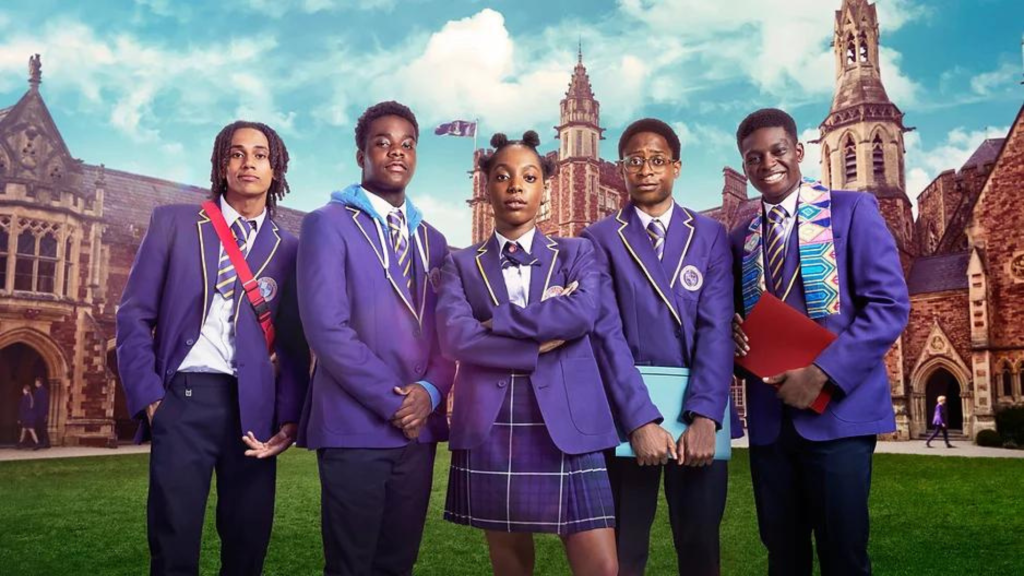
His latest project is a landmark achievement in higher education the Boarders Original Soundtrack, a genre-spanning album created entirely by undergraduate music students for the BBC comedy drama Boarders. Featuring 18 original tracks across two series and mastered by Grammy-nominated producer Ikon, the album reflects a bold new model of collaboration between industry and education. Here, Riley shares what it means to redefine opportunity through sound.
Now with the Boarders Original Soundtrack, created alongside his students and inspired by the BBC series, Riley returns to creative production, bringing his legacy full circle while platforming the next generation. Here, he reflects on the power of sound, storytelling and passing the baton.
Please introduce yourself…
Mykaell Riley, from Birmingham. British Jamaican. Leo.
Describe your life currently in one word or a sentence…
My life is a hectic mix of research, artistic discovery, and creativity, coupled with an unwavering commitment to
manifesting projects that illuminate and celebrate the profound contributions of Black culture and achievement.
Why are we here?
Philosophically, we’re the universe’s way of experiencing itself. Matter organised in such a way that it can
contemplate its own existence. We’re meaning-making creatures in what might be a meaningless cosmos, creating purpose through connection, creativity, and care. In my work, documenting and celebrating Black musical heritage, I’m transforming the raw material of experience into something that helps others understand who we are and
where we come from.
Tell us about how the BOARDERS music project first came about?
The BOARDERS music project resulted from producer Ali McPhail (a friend I’ve worked with over the years) approaching me during the lead-up to the Beyond the Bassline Exhibition opening, with this opportunity. She said, ‘you’re the best man for the job, let’s find a way to make this work‘ so I suggested engaging my students as co-writers. We then convinced both the production company on her side and the University of Westminster on my side that this was a viable proposition benefiting all involved. It’s been a steep learning curve for everyone, but the results speak for themselves. We’ve delivered the BOARDERS original soundtrack across two series, an album distributed by Warner Music, and 35 IMDb credits for the students – in a format that does not exist in any other music course.
You’ve worked across the music industry as an artist, producer, researcher, and educator. What does the BOARDERS Original Soundtrack represent to you at this point of your journey?
A defining thread throughout my work has been transferring knowledge and experience to others while exploring uncharted creative territories. The BOARDERS soundtrack embodies this philosophy channelled through emerging artists. At this point in my career, it’s profoundly life-affirming.
The BOARDERS soundtrack project is a unique fusion of education and industry. How did you integrate the students you worked with into this professional setting, and how does this align with your vision for music education?
Integrating students into BOARDERS required bringing the production company and their team into the University, while embedding University students and staff into modified curriculum content. This provided real-time integration into Studio Lambert’s professional production environment, with added benefits of payment and BBC national
network exposure, for students whilst engaging with their primary passion of making music. This is my ideal scenario for Music education. Our Head of School, Catherine Dormer, assistant Lucy Harrison, and Studio Lambert
were fully onboard, but developing, managing and delivering this project alongside my existing workload fell to me. Success hinged on my ability to adapt so the creation of the BOARDERS soundtrack worked for everyone involved.
Can you discuss the challenges and rewards of mentoring students through the BOARDERS project? Were there any moments that stood out to you during this collaboration?
Moving students into working within a professional environment with a professional attitude comes with its own set of challenges. Talking about a contract in the classroom and working within a professional agreement is one of the challenges that presented its own stand out moments.
Having agreed the terms of the contract, I zoomed in on how individuals would be paid, song splits, and the complexities of co-writing. In one co-write, the students initially agreed how they would split the song, prior to its acceptance onto the album. This was the case for all songs however, one of the writers decided they were not happy with their share of the song. As the song was a potential single, myself, everyone from the production company, and the other students involved tried to persuade this individual. But we failed, which meant the song was dropped from the project. This was a hard lesson for the students involved, but a real-world insight as to why some of the best songs were never heard.
The album spans genres from Afrobeats to Electronica. How did you guide students to explore that range while staying true to themselves and the series’ narrative?
Having given students, the brief, they really ran with it. The diversity of music they came back with was exceptional, and in such quantities, it allowed me to build a person with a focus on their unique experiences and cultural references. I’m fortunate in having a global mix of students that include individuals from Mexico, Paris, Canada, the UK and India. My first concern was that they made music they love. Then where necessary I worked with them to stylistically reflect certain genres.
From the production company perspective, the students provide fantastic resource in terms of musical options. Daniel Lawrence Taylor, the BOARDERS writer, and producer Ali McPhail, were initially surprised at the quality and diversity of original music available; and that it competed with chart music that would usually have a hefty license fee attached. Daniel’s very particular with regards to how music is positioned next to the dialogue. So having this flexible soundscape, is what made the whole interaction work.

What was the most challenging part of this process?
Dealing with each writer on an individual basis. This means a unique collection of creative and emotional conversation is attached to each brief and this can be draining.
What surprised you the most about the students work and the process as a whole?
Having tutored some of these students for up to 2 ½ years, I guess it’s observing the transformation from students to professional writers, producers and artist. Students need a challenge and BOARDERS hit the spot. There were other moments like the first screening, where I watched students wait for the end credits, just to see if their names
came up. And as their names appeared, to see, their faces change from angst to joy, was emotional.
Was there a track or moment while making the album that really stuck with you?
There’s more than one track for different reasons. The first was ‘Never be the same’ by DOCTOR JAY (aka Joseph Burnett). The song had to underpin an epic final scene of series one, on a high. It was the point where the characters on screen realise they’ve survived the first semester. On occasions, Joseph and I we were to-ing and fro-ing up until 3am, to hit the deadline. But when it dropped in the studio, everyone looked at each other, commented on their goosebumps and said, ‘You smashed it!’. I was almost in tears.
Is there a lyric, moment or memory from this project that really sums up what it’s all been about for you and what you hope it means for the next generation of young Black artists coming up?
There’s a classic moment in one of the episodes where the actress is in a car singing along to her favourite song on the radio. The song is a commercial track sourced by the Music Supervisor that fitted perfectly. However, after great deliberation it was decided it’s just too expensive; and because the scene was shot and edited some time ago, we
not only replaced the music, but synced it to the lips of the actor. Within four days, the challenge was met by Sydney Yack, one of our students who has since graduated and returned home to Canada.
Reflecting on your journey from founding member Steel Pulse to leading the Black Music research Unit, how have your early experiences influenced your academic and educational pursuits?
I think one of the most important early lessons I’ve learnt starting with Steel Pulse is that musicians are just people, and that working in the music industry will at some point bring out the best and the worst of our personalities. It is just human nature. I also learned that most of us have not had any schooling to deal with success. This includes
the work involved in gaining success, as much as what it means to move forward with success. My parents drilled into me that as a black male, I have to work twice as hard to get half as far and this is so true. I’ve fought for every ounce of success within music and even more so within academia.

Having been involved in projects like the Reggae Philharmonic Orchestra culture research. Beyond the baseline, how do you see the evolution of Black British music and what role does education play in preserving and promoting this heritage?
I think one of the things you realise is that the only constant in life is change and we need to be part of that change. We have a say in how the world sees Black British music and its contribution to British culture. If we all can be part of that change, this work gets a little easier. But it’s also important to say that the change we seek is constantly met with resistance from a culture that still will views us as alien. So, if I’ve learned anything, it’s that we can’t take our foot off the gas pedal. This is a fight not to be erased. It’s within academia that I realiasd the how, why and the rate at which our contributions were being erased, hence moving into the museum and heritage space.
Your research has significantly impacted the recognition of Jamaican music’s influence in Britain. How do you envision the future of black music research and what areas do you believe require further exploration?
In terms of Black British music research, we’re still new to this activity as there’s not enough, qualified and recognised researchers. There is so much that stays hidden, lost or not properly profiled. As a community, it’s for us to wake up and own this job. The Americans have done a fantastic job at promoting Black music. So much so that when black music is mentioned, often the first thought is not Africa but America. In contrast the world doesn’t think of Britain as a primary location for Black music. So, we have got our jobs cut out.
With your recent RSL fellowship, acknowledging your contributions to music education, how do you plan to leverage this recognition to further your work and inspire the next generation of musicians and researchers?
Indirectly without the RSL fellowship, I would not have got involved with University of Westminster. The person who first developed our music course, Norton York, also developed the RSL Fellowship. It is an exam or a certificate dependent on training and education that assesses your ability to be engaged within the music, and the music industry. So I think at the back of this is education, it’s how we look at qualifying within this space. Most of us are not qualified. We don’t have a piece of paper that validates our contribution, so I think it’s all about being serious about the job we’re engaged with. Studying the job, we’re engaged with and gaining a recognised certificate that we can travel the globe and say ‘Look, we are qualified’, alongside banging out the bars and the beats and the melodies and the lyrics.
Looking back, is there a particular project or achievement that you feel encapsulates your mission and passion for music and education?
I think it’s winning the Museum and Heritage award 2025 for Beyond the Bassline. I think kind of sums up the trajectory that I’ve been on and where Black British music needs to be seen.

GETTING TO KNOW YOU
If not this, then what? Writing my biography, gardening and restoring my classic car. That’s what.
What’s made you sad, mad and glad this week? I’m sad I’m still working three times as hard, but glad I’ve just confirmed I’ll be speaking
in Berlin in three weeks with Linton Kwesi Johnson. In general, I am mad.
What are you currently watching? I’m watching The Resident and The Studio.
What’s the last film you watched? The Equalizer 3.
Last play you saw? Retrograde.
Last live music event you attended? My daughter’s performance. George Riley.
What’s currently on your music playlist? The BOARDERS Original Soundtrack from the TV series which is available on all digital platforms and distributed by Warner Music, and the TV series is still streaming on
iPlayer.
Song on repeat at the moment? Gold by Joy & Jee Melodies, from the BOARDERS Original Soundtrack, it’s such a great song and incredibly catchy.
Which podcast are you currently listening to? Diary of a CEO.
What’s on your bucket list? A holiday.
My happy place is? In front of my computer. No, I lied. My happy place is tinkering with my classic car.
Celebrate someone else… Kanya King.
Celebrate yourself… Yeah, I need to find time to do that. I don’t do it enough. It was nice to win the Best Exhibition at the Museum and Heritage Awards this year.
What’s next? It’s a major project looking at the challenges for young people gaining access to music education. It focuses on Birmingham and Bradford.
Where can we find you? @BOARDERStv and @TheBMRU on Instagram The BOARDERS Original Soundtrack album is available on all platforms to stream now. Boarders season two is streaming now on iPlayer. Black Music Research Podcast – @basscultured – Bass Culture Youtube – Instagram.
BOARDERS has been commissioned for a 3rd season!