

London’s theatre scene has seen many plays mixing mythology with politics, but what Nigerian performance poet Taiwo Michael Oloyede creates in The Ghosts of Rainmakers at The Cockpit is masterful.
This emotional whirlwind unfolds like an epic story, drawing from Yoruba folklore to tackle collective modern guilt about destroying the environment, neglectfully losing memories, and abandoning spiritual roots. The play is an act of cultural rescue and a challenge to the audience about their role in collective forgetfulness. The writing is sharp, letting history, ritual, and imagination flow together naturally.
From the moment a cracked drum takes centre stage, the production announces its environmental and mythical nature. This drum serves as the heart of the play, a physical symbol of the story’s focus on survival through brokenness.
The stage design succeeds through simple but meaningful choices. The lighting works less to brighten the space and more to tell the story: shadows stretch into warnings of the future, rain appears through light patterns that cover the actors in flowing shapes. The sound design supports every beat and argument in the play’s main discussion about ancestors and renewal. Visually, the design focuses on basic elements: cracked earth spreads across the floor like veins, flickering lightning outlines the spirits as they gather, and a single calabash spills water that disappears before hitting the ground. Everything points to loss, consequences, and things that can’t be undone.
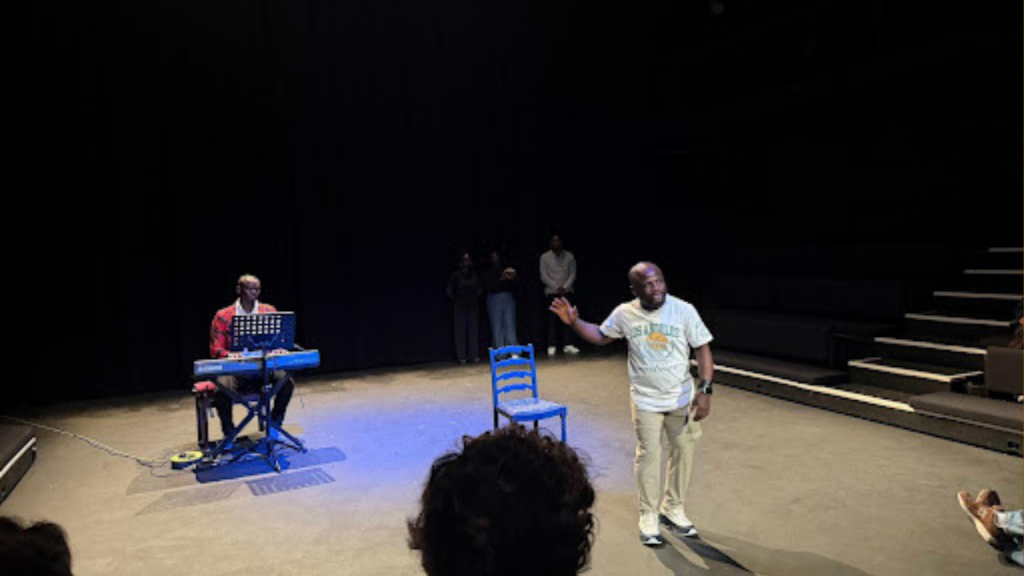
Kate Apaflo’s Ojonigbese is delivered with the conviction of a griot who has outlived her own myths. Her performance is both testimonial and indictment, her physicality a measured vocabulary of weight and release. Apaflo demonstrates the rare ability to hold tension in stillness, a quality that makes her pronouncements feel carved in the air.
Fagbolahan Machado as Orogbeni brings an elemental force to the production. His work operates on two registers: a visceral physical presence and a vocal timbre that suggests deep water, unhurried but unstoppable. He has the composure of someone who understands that time itself is his collaborator. In contrast, Nisola Jegede’s Yewande is understated to the point of transcendence. Jegede’s economy of movement is a dramaturgical choice that reconfigures the audience’s pace of looking; we are forced to attune ourselves to micro-gestures, to the subtlety of withheld information.
Oloyede as Kasali brings internal conflict into the otherwise measured rhythm of the group. His tonal changes – sudden but controlled – mirror the theme’s swing between taking action and hesitating. The role demands unpredictability without chaos, and Oloyede delivers with careful, almost artistic control Ileriayo Fadeni as Akanji offers the production its most complex emotional range. His comedy isn’t used to release tension but to bend it, showing the thin line between laughter and sorrow. His use of music as a structural thread gives the performance a rhythmic heartbeat, connecting different emotional states into one living thing.
What struck me most was the audience’s deep cleansing grief that left people feeling lighter after going through it. People held themselves, leaned forward as if seeking forgiveness in the next line, then sat back, shocked by the inevitability of what they had just seen. Crowd participation was engineered through a slow, almost ritualised encroachment. The audience finds itself implicated in the unfolding events because the spatial and emotional architecture of the performance dissolves the proscenium altogether. You realise, at some point, that you are not merely watching the ritual, you are inside it.

If there’s one unifying success here, it’s the cast’s restraint. This production understands the difference between theatrical skill and theatrical showing off. The actors demonstrate technical ability without letting their performances become self-display. There’s a shared discipline and common purpose that prevents any single performance from overshadowing the group vision.
The Rainmakers in this production are sharply examined. The ghosts serve as memory devices, reminders of unfulfilled obligations and misremembered histories. The work’s political power lies in refusing to let either character or audience hide behind vague ideas.
As a cultural critic, I’ve seen productions rich in design but empty in spirit, and others rich in spirit but poor in craft. The Ghosts of Rainmakers is, thankfully, neither compromised nor excessive. Oloyede’s writing shows the mark of a mind soaked in history, myth, and a concrete sense of human longing.
In the final image, with the cracked drum still present and still resonating, the performance achieves a rare balance between ending and continuation. The stage empties, but the object remains: a leftover energy source the audience carries out of the theatre.
This play succeeds because it redefines stage experience as a place for community reckoning.
The Ghost of Rainmarkers will get a staging in Nigeria when Oloyede graces this year’s Lagos Poetrython on Saturday 6th September 2025.