

Traditionally held in May, Cannes Film Festival is considered one of the most anticipated media events of the year.
Hailed for its response to art, political statements and culture, Cannes has championed upcoming filmmakers and provided a showcase for those returning to the Croisette. For non-white and non-Western filmmakers Cannes has historically been viewed as a place to receive ultimate recognition for films both features and shorts.
Athough, the history of African cinema at Cannes is not linear. It is a story marked by struggle against colonial narratives, uneven access to production and distribution, and the persistent marginalisation of African voices within international film culture. Yet across seven decades, African filmmakers have repeatedly transformed Cannes into a stage for radical artistic invention and political testimony.
World cinema is ever evolving and African cinema is pushing the boundaries of what it means to take up space in a traditionally Eurocentric and “traditional” focused landscape.
Discover the films featured in this article on MUBI as part of the African Cinema at Cannes collection — spanning everything from intimate personal stories to political history.
Get 30 days free of MUBI at mubi.com/thebritishblacklist to stream these films and many others.
Title availability by country:
- The Blazing Sun – Global
- Black Girl – Argentina Chile Colombia Mexico Netherlands Spain Brazil Australia France India
- Monangambééé – Global
- Touki Bouki – Global
- Chronicle of the Years of Fire – Australia India Turkey Germany Netherlands Spain Argentina Brazil Chile Colombia Mexico
- The Choice – Australia India Turkey Netherlands Spain Argentina Brazil Chile Colombia Mexico
- Abouna – Global
- Bamako – Global
- My Father’s Shadow – Global
In 1954 only two titles from North African filmmakers were a part of Cannes’ In Competition for that year; The Blazing Sun, directed by Youssef Chahine and The Monster, directed by Salah Abu Seif.
Chahine’s induction to Cannes was reflective of a shift in attitudes towards non-European cinema. Egypt, after all, began producing cinematic projections using a “Lumière” cinematograph just a year after Paris in 1896 and by the end of the silent film era the country had opened 86 cinemas as of 1926. A product of the studio era and a reflection on the 1952 Revolution, The Blazing Sun showcased that African cinema had the ambition to rival American and European productions with its emotional depth and technical prowess.
Chahine’s romantic drama tackled love across the class divide, feudalism, optimism in a post-revolutionary society and looks at the wider ramifications of law and how justice is delivered. On a much wider scale Chahine’s work gained recognition and he would go on to be one of Cannes’ most respected creatives; known as someone who commanded a global presence and yet never lost his sense of self and national pride.
Years later in 1966 African cinema shifted once more with the Senegalese film Black Girl by Ousmane Sembène. The film has been cited as one of the first to really break the international circuit in the Sub-Saharan African space. Though this reflection wasn’t supported during its initial release and has since gone on to be determined a ‘classic of world cinema’. Black Girl once more challenged the nature of film, looking intimately at migration as a manner of financial survival, digging deep into the exploitative reality of being a nanny for a well-off family in France.
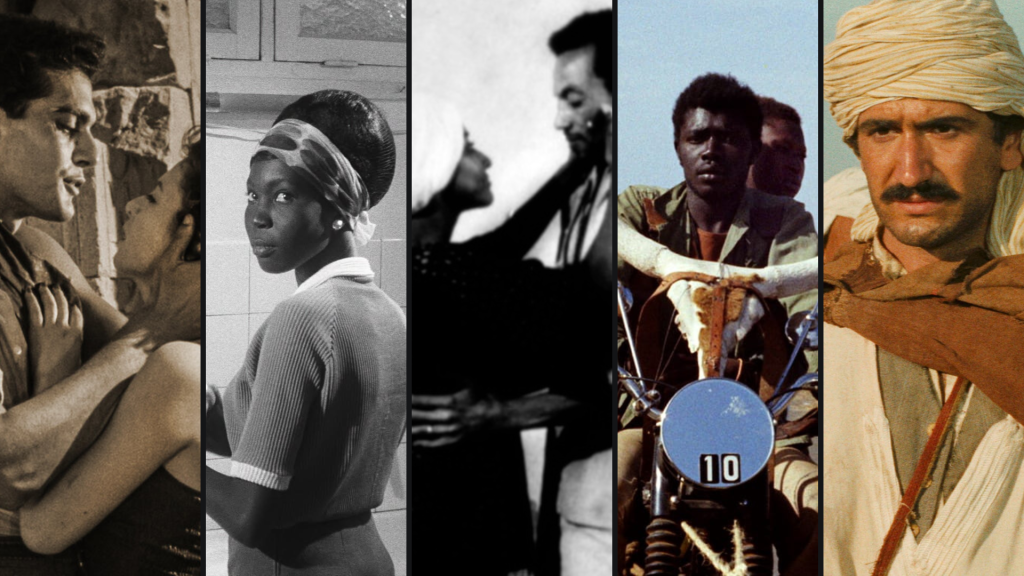
African filmmakers were making cinema on their own terms, pushing against the status quo and the echoes of colonialism. Films were socially conscious, aware and revolutionary. The revolution was taking hold and the continent was infectious with the spirit of rebellion. Monangambée by Sarah Maldoror, an Angolan filmmaker tackled the tale of how to resist colonial legacies in a short film which was named after the warrior cry of those fighting for liberation. Maldoror’s work shot to the heart of the issue of liberation, she also paved the way for female African filmmakers in her era allowing for women to experiment with form, being bold and allowing for European audiences to reckon with what colonial brutality meant in the context of the then modern age.
In the 1970s African filmmakers began to loosen their forms and thus began an experimental wave of new cinema. Djibril Diop Mambéty’s 91-minute film screened at Cannes in 1973, another Senegalese film it was ear-marked as being experimental and dreamlike. In a revolutionary departure of tradition and a step towards independence, Touki Bouki wasn’t financed by the French Ministry of Cooperation’s Bureau du Cinema; instead the film’s $30,000 budget was partly obtained via the Senegalese government. As someone who also stood for anti-racism, Mambéty would be arrested for participating in protests in Rome during the filming of Touki Bouki. He also rejected the genre of the traditional Western in his film, despite it displaying many of the genre’s early and distinctive markers.
There was a sense of freedom to Mambéty’s work, and it hasn’t been allowed to die out. In 2008 the film was restored by the World Cinema Foundation, a non-profit dedicated to the restoration and preservation of neglected World Media, founded by Martin Scorsese. The film’s reception at Cannes also highlighted just how far African cinema had developed outside of the continent and how it had become a politically significant tool in sharing what was happening with the rest of the world.
The revolution reached a peak when Chronicles of the Years of Fire by Mohammed Lakhdar Hamina won the Palme d’Or at Cannes in 1975— still the only African film to receive the festival’s highest honour. The film’s storytelling which followed Algeria’s anti-colonial resistance once more proved that African histories were important and could be scaled for the big screen all whilst remaining politically astute. The win was monumental not simply because of the award itself, but because it forced the international stage to recognise African cinema as central rather than peripheral to world cinema history.
By the 1980s, filmmakers from sub-Saharan Africa were increasingly using Cannes to interrogate post-independence realities. The Choice by Idrissa Ouedraogo explored the tensions between tradition and modernity with quiet humanism. Ouedraogo’s work reflected a generation confronting the unfinished promises of independence, where political liberation had not always translated into economic or social justice. His films brought emotional intimacy to African cinema’s global image, complicating stereotypes of the continent as either tragic or exotic.
The early twenty-first century introduced filmmakers who examined migration, conflict, and globalisation through deeply personal narratives. Abouna (2002), by Mahamat Saleh Haroun portrayed abandonment and longing through the eyes of children in Chad, revealing how political instability leaves emotional scars within ordinary families. Haroun’s restrained storytelling showed that African cinema did not need spectacle to achieve universality. Similarly, Bamako (2006) by Abderrahmane Sissako transformed a courtyard trial into a bold critique of global economic inequality. The film symbolically placed international financial institutions on trial for Africa’s hardships, blending satire, realism, and political philosophy. Sissako’s cinema exemplified how African filmmakers at Cannes increasingly addressed not only colonial history, but also the contemporary systems of global power shaping African life.
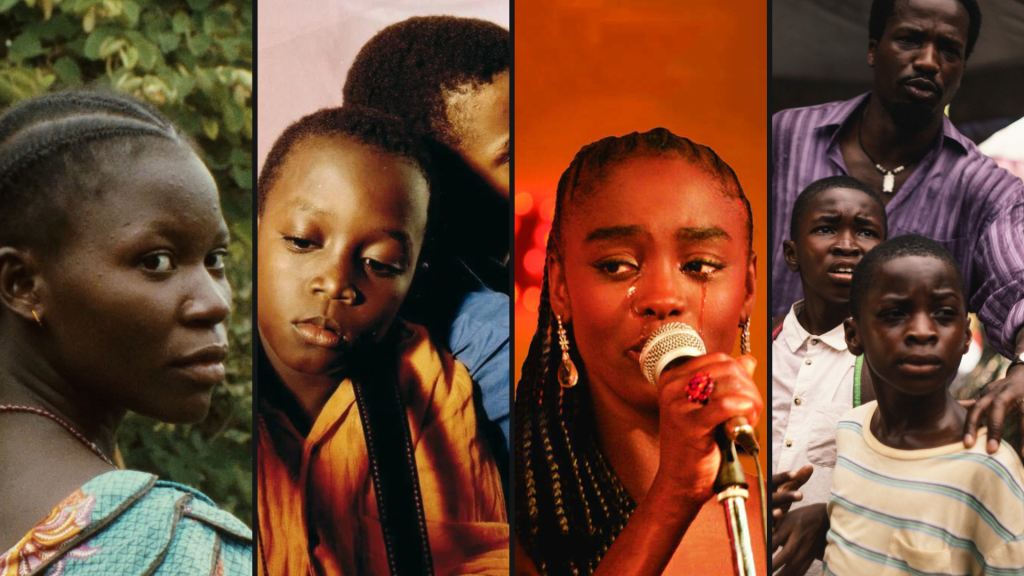
Today, that cinematic lineage enters a new chapter with My Father’s Shadow (2025) by Akinola Davies Jr. The film made history as the first Nigerian feature selected for the official lineup at Cannes, marking a transformative moment for Nigerian cinema and for Nollywood’s relationship with the global art-film world. Set during Nigeria’s turbulent 1993 election crisis, My Father’s Shadow combines personal memory with national history, following two brothers navigating Lagos with their estranged father amid political unrest. Critics and audiences have viewed its Cannes selection as symbolic of a broader evolution in African cinema; one where commercially powerful industries like Nollywood increasingly intersect with auteur-driven international filmmaking.
The future of African cinema has been bolstered by Davis Jr’s film’s success across the global stage. Winning at the 2026 BAFTA Film Awards has meant that Davis Jr is reaching wider audiences stages thanthat those who are interested in world cinema outside of Cannes attendees and consequently this has had a ripplehas a ripple effect across the continent, with more filmmakers entertaining the idea of submitting their films to Cannes and beyond.
The significance of African cinema at Cannes ultimately extends beyond awards or festival recognition. These films collectively challenge who gets to shape cinematic history. They reject the notion of Africa as merely a subject of observation and instead position African filmmakers as architects of cinematic language and trend.
From Sembène’s anti-colonial reality to Mambéty’s surreal experimentation, from Maldoror’s revolutionary poetics to Davies Jr.’s intimate political storytelling, African cinema at Cannes has continually expanded the possibilities of film form and political imagination. It has offered audiences not one Africa, but many Africas, each unique and universally welcomed for their desire to tackle larger world issues through the lens.
African filmmakers have transformed Cannes from a European showcase into a more contested and globally representative cultural arena. Their work reminds the world that cinema’s future cannot be separated from the voices, histories, and innovations emerging from those reckoning with rebuilding economies and cultures after colonialism. The next step; more films backed from in house arts programmes and funding pools and a wider celebration of female and non-binary filmmakers experimenting with form on the global stage.
There are 54 countries on the continent; that’s millions of more stories, struggles and hopes represented on the big screen.
Explore AFRICAN FILMS AT CANNES, now streaming on MUBI. Watch the collection via the official platform.