

Nova Reid is an award-winning author, TED speaker, and producer dedicated to challenging perceptions around race, identity, and history.
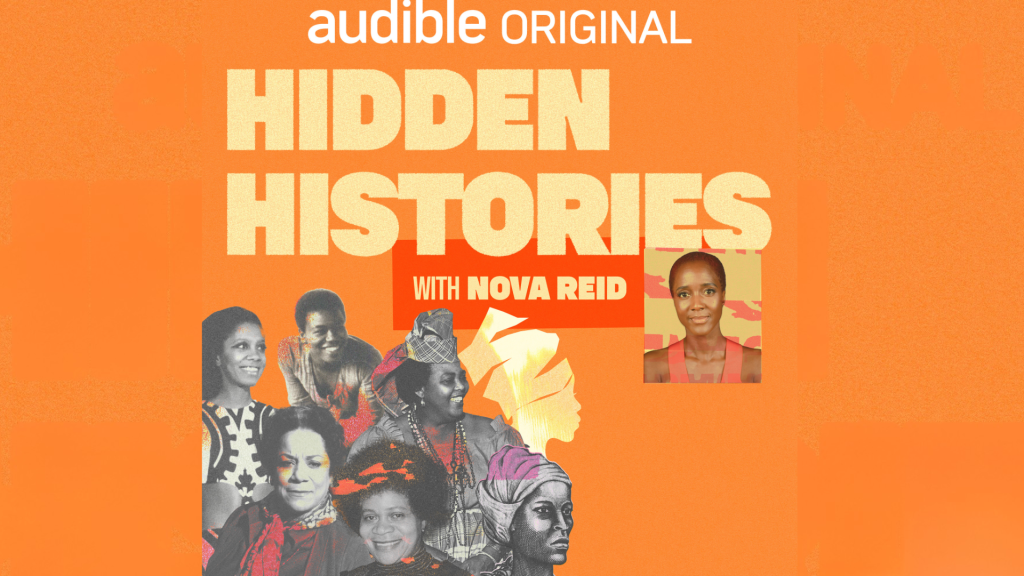
Her latest project, Hidden Histories With Nova Reid, is a compelling six-part Audible Original podcast illuminating the overlooked contributions of Black women who profoundly influenced British and global society. Here, Nova reflects on her personal journey of bringing these vital stories into the light.
Please introduce yourself
My name is Nova – which means new. It’s also the name of the brightest star in the sky. I am British-Jamaican and I am a Libra, so I truly love balance – in every sense of the word.
Describe your life currently in one word or a sentence.
Evolving.
Why are we here?
I ask myself this question a lot. I believe we are here to do the work past generations couldn’t. I truly believe we are here to leave the world in a better place than when we entered it and I believe we are here to progress generational healing
Tell us about Hidden Histories with Nova Reid in your own words…
Hidden Histories with Nova Reid uncovers the untold stories of extraordinary and deliciously disobedient Black women who shaped world history, British culture, and society. I had the seed of the idea to create the show when I first started writing my book The Good Ally over 6 years ago. My lessons in history where Black people were acknowledged beyond subjugation, came as an adult. As I was researching my book, I learned in detail about large volumes of resistance that happened in the Caribbean – particularly Jamaica and I was intrigued by it. I was frustrated that I hadn’t learned about empowering stories from pioneers at school, like Cubah Cornwallis, a powerful healer who used plant medicine to heal, or Queen Nanny of the Maroons – a spiritual warrior who annihilated British colonial forces. Instead, I had to endure King Henry VIII, on repeat.
What inspired you to create it, and what drives your approach to storytelling?
I wanted to learn more about these women – not just about what they achieved, but who they were beyond their roles – I wanted to centre their humanity, as so often Black women are reduced to what they do and not who they are. I was headhunted by a development producer years later to create something for Audible and pitched some ideas – including this one (I have more ideas than time) and it stuck.
What’s your role?
I am the host, one of the executive producers and also co-writer on this show
Yes to women’s stories being unhidden, especially Black women’s, but when did it become necessary for you personally to join the journey to bring these stories to the forefront? Why you?
Why not? I’ve always been a writer and storyteller. When I wrote my book – it didn’t feel like a choice, it was something that needed to be birthed, it needed to be witnessed, and I trusted it was going to happen. This was the same.
I am naturally curious and if things feel unjust or don’t make sense to me, I want to deeper understand them. I want to seek the truth. I’ve always been like that. Misogynoir – ( a term coined by Dr Moya Bailey) the combined experience of sexism and racism, worse than experiencing either on its own, means that Black women’s work is often erased, passed off as others or deliberately hidden, it’s a persisting systemic and historical issue. So, if we don’t tell our stories, who will?
How did you prepare to delve into these historically significant yet underrepresented stories?
Some of the research I had delved into when writing my book so it meant returning to it and deciding which aspects of their stories I wanted to tell, and dig deeper and wider. It was so important to me to humanise these women. As someone often referred to as an activist I am so often minimised to what it is that I have done, rather than who I am as a human being. So it was important to try to find out who these women were beyond their contribution and beyond struggle.
With so many stories available, how did you decide whose stories to highlight?
The women picked me as much as I picked them. I was led by the stories most hidden, or the aspects of the women’s humanity that felt non-existent, or incomplete, that fed my curiosity. Plus all of the women are Caribbean, that was important to me, as their stories are interwoven with mine in this show.
Speak on the editorial style of the podcast. You have narration, background sounds, and live interviews – how did you come up with the production, and who were your essential team members?
I work very emergently, which was a source of contention for most of the production team. I want to write about what moves me, not what is pre-scripted, that bores me. So, at times, the story changed direction based on stimuli we would get from a conversation with a contributor, if what they shared piqued my interest. For example, one of our pioneers, Miss Lou, wasn’t one of the original women I picked, she came up during a live interview and I was like “I have to include her”.

Every single person at every single stage on a production plays a crucial role. Along with strong editorial, Audible were clear from the beginning that they wanted the podcast to be immersive so we really take our listeners on a journey. Some listeners have said it’s like going on holiday with a friend. So sound design, done by the team at Ai Ai studios, was a crucial aspect. From the bird song in the Blue Mountains, to the laid-back bustle in Kingston, Jamaica and the gospel sounds of a church organ. As well as my theme tune music used throughout the show, which has the most delicious reggae lick.
Our Jamaica fixers were key in ensuring basic needs were met, along with understanding how to navigate tricky terrains and ensuring our safety. Our contributors were also crucial as most of the women we spotlight in the series died many decades ago, so getting the detail of personal and expert accounts were key in bringing their humanity and stories to life.
What did you find most challenging about creating this podcast series, both technically and emotionally?
There were a lot of challenges on this project, some unexpected and some totally avoidable. We had to reschedule our trip to Jamaica due to hurricane Beryl causing devastation across the Caribbean and had to contemplate a complete pivot, including not recording in Jamaica at all, which would have altered the entire series. More generally, there were many times I felt like a deliverable and not a human being. Too often safeguarding is not even considered on productions and unhealthy work cultures are normalised and that was incredibly challenging.
Some of our episodes take us back to when the Caribbean was under British colonial rule and the harsh realities of that. Trauma is present. I also have lineage lost to slavery, and my stories are interwoven throughout many of these women’s. We have many parallels. I am interacting with my own humanity and my own experiences of dehumanisation in real time. It takes, and took a toll. The emotional toll of not just researching, writing and presenting tough stories, but holding space for contributors who were sharing about their own personal experiences with death and trauma was grossly underestimated.
What was the most rewarding?
Being able to contribute to archiving some extraordinary legacies. And post launch, seeing people take photographs with their young children next to billboards, of images of all our women from the show, has been pretty special. And on Mother’s Day, I received the most beautiful message from the family of one of our women thanking me for recognition and choosing to tell their mother’s story. I was deeply moved.
At the beginning of the podcast, you share a gentle love note, offering listeners a warning about the emotional impact they may experience due to the nature of these stories. As a mental health practitioner, how did you take care of yourself while navigating these narratives?
Yes, absolutely. Wellbeing is very important to me and it wasn’t always respected by everyone on the team, which took a toll and meant that even I didn’t always manage to look after myself as best I could. It was really hard.
I mostly took care of myself with lots of bodywork, swimming and meditation several times a week. Building in rest days in my contract. When things got tough, I doubled up on therapy (twice a week). And voice notes. Hours and hours of voice notes and phone-calls with my mates and given my former professional background in mental health, it helps that many of them happen to be Buddhists and psychologists.
Whose story affected you the most, whether positively, negatively, surprisingly, or otherwise?
Gosh all of them affected me in some way. Olive Morris is one and has been a standout to many listeners too. She was a radical Black feminist and did so much for so many people and we really get to the essence of her playful and feisty character. We look at when Blackness and queerness intersect and how homophobia can reveal itself and leave listeners with the reality that even though activist spaces are supposed to be, they aren’t always safe for everyone. Olive’s story also stands out because of her premature death. Her symptoms were dismissed by doctors, which is something so many Black women continue to experience, along with the exploration of grief when we lose people we love, both of which have opened up some important conversations.

I think Barbara Blake-Hannah (the UK’s first Black female TV reporter) impacted me the most, not just because of what happened to her while she was in Britain, or her gorgeous vitality, but because she is our only living pioneer. So to hear her tell her own story and to express such gratitude for choosing to feature her was very special.
Do you have a favourite quote or moment from the series that truly defines what this journey has meant to you?
There were so many moments, but for me it was a personal thank you from Barbara Blake-Hannah and educational leader Gertrude Paul’s family. That’s what it’s all about for me. Acknowledging, honouring and recording their legacy and doing it respectfully. I’m really proud of that.
GETTING TO KNOW YOU …
If not this, then what? A little retreat/healing space in the Caribbean helping people reconnect to the land, themselves and aid generational healing, and hosting my own chat show.
What’s made you sad, mad, and glad this week? People dying, global politics, randomly seeing my face on a billboard on a tube on the way to dinner with friends.
What are you watching? Number One on the Call Sheet on Apple TV.
What are you reading? Fun fact, I don’t really read books, I much prefer to listen to them, as I’m a strong audio processor so I have multiple on the go. What it takes to Heal by my dear colleague Prentis Hemphill, Lovers Rock – Calabash Festival, Trevor Noah Born a crime (for the 4th time).
The last film you watched? The Woman King (for the 7th time).
The last play you saw? Retrograde.
The last live music event you attended? Ayo, at Camden Jazz Café. Dreamy.
What’s currently on your music playlist? What’s not on it!
Which song are you listening to on repeat at the moment? Hero – Kirk Franklin.
Which podcast(s) are you currently listening to? Hidden Histories with Nova Reid, and Trevor Noah’s What’s Next?.
What’s on your bucket list? Living in the Caribbean and directing a major film.
Where’s your happy place? Laying on my back in the Caribbean sea being held by the water.
Celebrate someone else… Kym Oliver. Researcher, writer and founder of Our Living Archives centring intracommunal healing and archiving the lives of Black disabled women and gender expansive people.
Celebrate yourself… Woo, this one was tough (a sign I don’t celebrate myself enough). Seeing Hidden Histories with Nova Reid get the commercial support and visibility it deserves and our women, Black wome, once hidden, on hundreds of billboards up and down the country. That’s been a moment.
What’s next? We’ll see.
Where can we find you? @novareidofficial on Instagram | Substack | website: www.novareid.com.
Where can find your latest work? You can listen to Hidden Histories with Nova Reid on Audible and stay up to date on my website: www.novareid.com Substack or socials to see other work.