

Africa “Pensage” Ukoh is a Nigerian playwright, theatre director, screenwriter and producer.
His writing credits in Nollywood include feature films like The Razz Guy (2021), The Lost Okoroshi (2019) and Green White Green (2019).
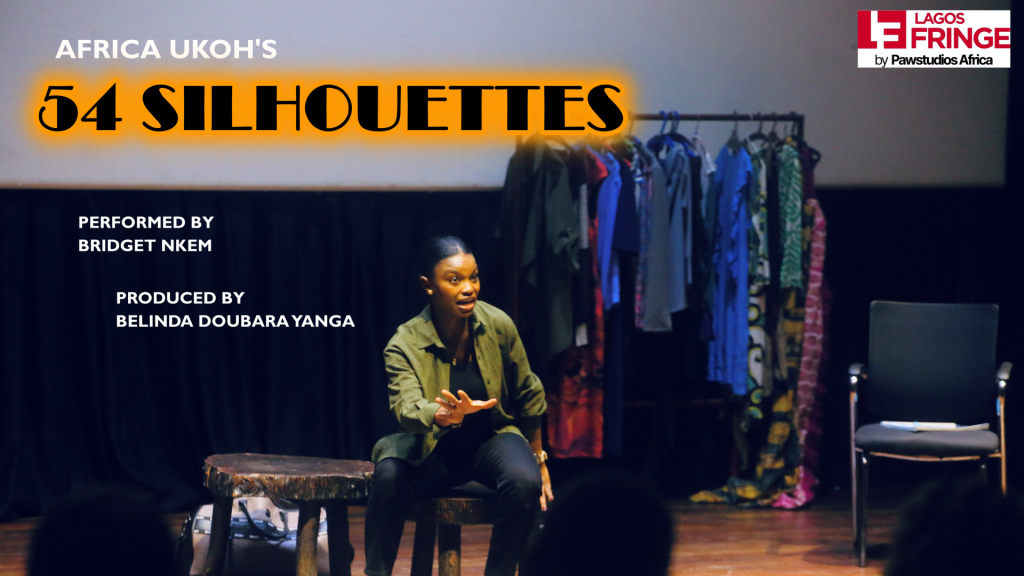
Ukoh’s latest work is a new iteration of his stage play 54 Silhouettes, a stinging critique of the stereotypical depictions of Africans in Hollywood. It focuses on the story of struggling Nigerian actress Victoria Chimezie (played by Bridget Nkem), who gets the biggest opportunity of her career when her agent lands her a role in a big-budget American action blockbuster. There’s only one problem: the movie is exactly what she vowed to never do again – another “war in Africa” film. Torn between career ambitions and her personal convictions, Victoria is faced with a trajectory-defining dilemma.
We spoke to Ukoh about 54 Silhouettes, portrayals of Africa in global cinema, and the theatre scene in Nigeria.
Introduce yourself…
My name is Africa Ukoh. I’m from Nigeria (shout out to J-Town). I’m a playwright, screenwriter, and theatre director. And when the muse is bothered enough to speak to me, I spit out spoken word poetry.
Describe your life in one word or a sentence.
A soul going through its journey.
Tell us what 54 Silhouettes is about in your own words.
54 Silhouettes is about a struggling Nigerian actor in Hollywood who finally gets a shot at fame and fortune when they land a role in a big-budget blockbuster, only to discover it’s exactly what they swore to never do again—another “war in Africa” film centring ugly stereotypes about the continent and its people. It’s originally a 5-character full-length play. The version being currently run across Nigerian theatres is a one-woman adaptation.
Where’d this story come from?
One day back in 2011, I found myself wrestling with a mess of feelings about the portrayal of Africans on the global arts and media scene. There was a knot of frustration in my stomach as I realised that almost every time I’d seen Africans on a screen, it was tales of poverty, sickness, and all the other “greatest hits.” There was a second knot in there as I wondered about what we Africans had done to take charge of our image, our narratives. It’s fine to say to someone, “You’re not telling my story right”, but at what point do you get up and tell your story yourself?
Telling your own story can’t just be showering yourself with adulations, that’s just the opposite extreme. Then there are the socioeconomic complexities that come with being able to tell your own story widely enough to have an image-shifting impact. I wrestled with all this while hunched over sheets of A4 paper, and what came out was this story about the tensions of cultural exchange, the challenge of creative responsibility, and the conflict between career ambitions and personal convictions.
How did your writing process differ from your last project?
My last project, generally speaking, was a series, so that’s a significantly different process. For plays, I prefer to jump in and sit with the dramatic problems as they arise, while for a series you have to do the extensive development work beforehand.
But compared to my last stage play, the process was basically the same. I had a premise I was comfortable with it and I just jumped in. It’s essentially a balance between basic planning and a stream-of-consciousness approach. The one difference is that for my last play, I had a key story turn in mind right from the start.
Were there any story blocks?
Nah.
Which parts of the story just flowed effortlessly for you when you were writing?
All of it. It was one of those multi-orgasmic circumstances where the thing just keeps rushing out of you until it’s exhausted. I rewrote about ten per cent of it in 2014, and that was a slow and heavily calculated process because then you’re building new parts, moving old ones around, and throwing away some entirely, all while making sure the whole thing stays one unified piece.
A scene or a line that best captures the essence of 54 Silhouettes.
“There is a completeness to people—good, bad, ugly, beautiful, and so much more between. Completeness. And when you deny them that, you deny them existence. You kill them. Lord knows I am tired of being a murderer.”
Previous iterations of this play featured a male character. What influenced the decision to present a female perspective in this current run for 54 Silhouettes?
Well, its original form is a 5-character stage play, with the characters being four males and one female. Then it’s been a radio play and a one-man show. So, this one-woman adaptation is another adventure in stretching the material as it journeys through mediums. Also, the producer (Belinda Doubara Yanga) and I are big lovers of acting, so given that it’s an actor’s piece, we were excited by the thought of an actress getting a turn at diving into the solo-performer version of the material.
What fresh angles to the conversation should old and new audiences expect from this current interpretation of the play?
People will always bring who they are into the show and walk out either affirming or challenging that. Generally, audiences always play the “What would I have done if it was me?” game with themselves after seeing it.
Drawing from the play’s premise, do you feel that much has changed about the kind of “African and black stories” greenlit by Hollywood studio executives since you first wrote this in 2011?
It feels like an unsolved Rubik’s cube: so much has changed but the parts move such that so much has stayed the same. It’s like some paradox of simultaneity.
But it’s not just a question of Hollywood. See? It’s also internal—primarily internal. What have we changed? What are we changing?
In what ways has the evolution of this work, and the way it has assumed different lives, influenced you as a black and African creative?
It continues to teach me the value of flexibility and the importance of collaboration. The solo-performer version was born out of a seeming accident and the spirit of spontaneity. An actor friend needed material for a festival and the quickest thing we could do was adapt the 5-character original into a one-man show. Sometimes, the spirit of adventure takes you to more interesting places than all the manic career calculations.
Comparing the way Broadway exists side-by-side with Hollywood in the United States’ creative ecosystem, do you feel that theatre in Nigeria is any close to becoming robust and hallowed in the way that Nollywood is (aspiring to be)? What do you think about theories suggesting that Nigeria’s theatre scene is a mere extension of the movie industry?
Nigerian theatre is considerably older than Nigerian film, but they are both still very, very, young industries. They are so young that I personally don’t think being hallowed or any bother of that sort should be either of their respective focuses. You need to get good, then get better, then hit and stay at a high level for a sustained period before worrying about being revered. The reverence comes naturally if you get good and stay good.
Film and theatre are half-siblings, so anywhere you go they are extensions of each other in some way.
Getting To Know You …
What are you watching?
I am currently in the liminal space between “just finished watching something” and “figuring out what to see next.”
What are you reading?
Isabelle Allende’s The House of Spirits and Jez Butterworth’s Jerusalem.
The last film you watched?
Jim Jarmusch’s Dead Man. Terrific picture. So full of a soul.
The last play you saw?
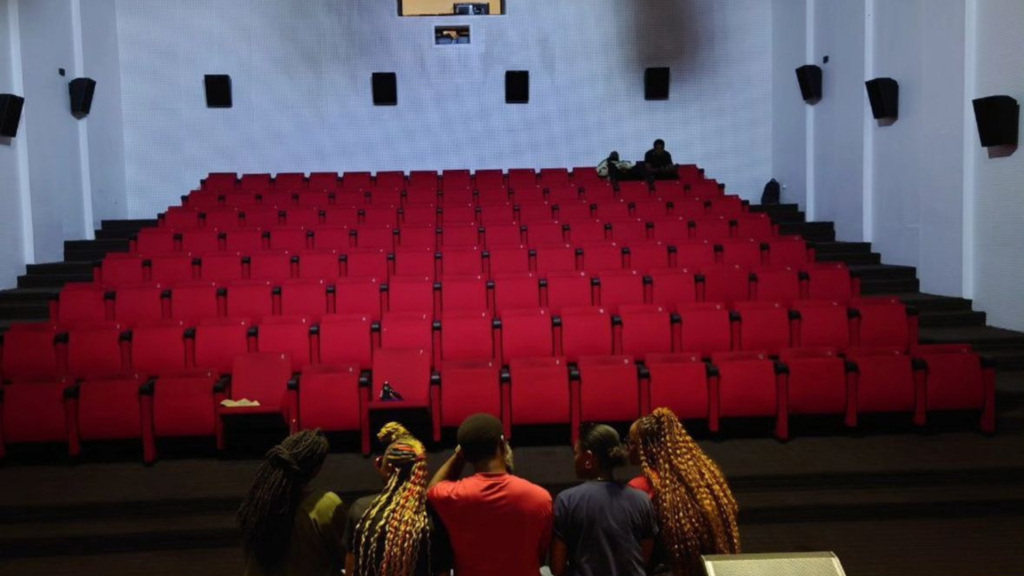
Mine. The one-woman adaptation of 54 Silhouettes at the Alliance Française Centre in Lagos.
The last live music event?
Singing in the shower this morning. The tickets were overpriced.
What’s currently on your playlist?
Kemba’s Brown Skin Jesus and What a Day.
Leonard Cohen’s It’s Torn.
Nina Simone’s Don’t Let Me Be Misunderstood.
Frank Sinatra’s Strangers in the Night.
A whole bunch of Ali Farka Toure.
A miscellany of traditional Yoruba songs
What podcast are you listening to?
You know, I’m one of those who just haven’t gotten into podcasts. I don’t even know why, because I love the few I’ve given a listen. But I am obsessed with Arlette Amuli’s Pop the Balloon or Find Love on YouTube, so that sort of counts, I guess.
What’s on your bucket list?
Avoid buckets.
Where’s your happy place?
[Bleep]
Celebrate someone else
Lynne Ramsay is the GOAT. Kemba is the truth.
Celebrate yourself.
*Sprays confetti on self*
What’s next?
I can’t share yet, but hopefully one or two become public soon.
Where can we find you? (socials)
Twitter, Instagram: @Pensage
Bluesky: @pensage.bsky.social
In the streets: sipping on gin and juice.
Where can we watch you at work?
You want to watch a writer staring into the void for six hours? Why?
There are some copies of 54 Silhouettes in the bookshop at SOAS University of London, and I think The Lost Okoroshi is still on Apple TV+.
54 Silhouettes was selected for the 2024 Lagos Fringe Festival, scheduled to run from 19-24 November. The play will travel to other African cities, including Abuja and Accra, in the coming months.